We are still working toward a mostly-online system of reserving time to use the laser. And, I still don’t know when that system will be ready.
In the meantime, the way to get time on the laser is to send your desired date(s) and time(s) to Vic, who can be reached by DM on the sdcapgroup Slack workspace as @Jolly Rancher, or by email at jollyrancher@sdcolab.org. Vic is a busy person and also a volunteer, so please be patient and friendly.
Reminder: you must have completed the Basic Operation and Safety class on the laser before you can reserve time on the laser. If you took the class before Covid at the original Colab location, you’ll need a refresher. For the moment, that means retaking the BOS class. If you’d rather wait until we can offer an abbreviated refresher course, please let me know. I won’t be developing the refresher course unless I hear about some demand for it.
Sessions of the Basic Operation and Safety class for the laser are continuing at an accelerated pace: 4 sessions in March, 6 in April. I’ll try to keep this up as long as there is demand.
For now we are going to try to stick to a schedule for scheduling new classes. Specifically, new classes will be added once per calendar month, sometime during the last week of the preceding month. Classes might still be added or changed at any time, but most new classes will be posted in a single batch during the last week of the month before they occur. The purpose of this schedule is to limit the number of volunteer hours needed just to maintain the schedule.
I’ve always preferred that the BOS classes be free, because they’re essential to the use of the laser and we do want people to use the laser. However, we’ve found that the number of people who sign up for the free class and then fail to show up is unacceptably high, given the high demand for the BOS class. So for the moment we’re charging a nominal fee of $10 per student, in the hope that this will discourage people from skipping out on a class reservation. If this doesn’t work, we’ll have to resort to drastic measures, like making people pinky-swear that they will show up for class.
Work is underway to add a camera to our laser. The camera will be installed on the underside of the laser’s lid, looking down onto the bed. After you’ve placed your material on the work bed of the laser, you’ll click the camera icon. This will take a snapshot of the bed with the material placed, and make that snapshot the background in the drawing area of the Lightburn software. It will then be easy to draw your design right on the image of your material, without having to fiddle around with aligning your material with your drawing. This has proven to be a nice convenience on newer model lasers that come equipped with a camera, so we can expect it to be helpful when added to our laser, which is now almost twelve years old.
For this to work well, the camera has to be in the exact same 3-dimensional position every time it’s used as when it was installed and calibrated. Our laser’s lid wasn’t originally designed with this requirement in mind, so I’ve made some modifications. Our laser already has an upgraded hinge, because the original hinges kept breaking. I replaced the four tiny cast aluminum (!) hinges with a beefy steel piano hinge running the full width of the lid. This hinge has very little mechanical play, so the camera’s X axis is well defined, as is the distance from the hinge pin to the camera. That just leaves the angle of tilt of the lid when it’s open.
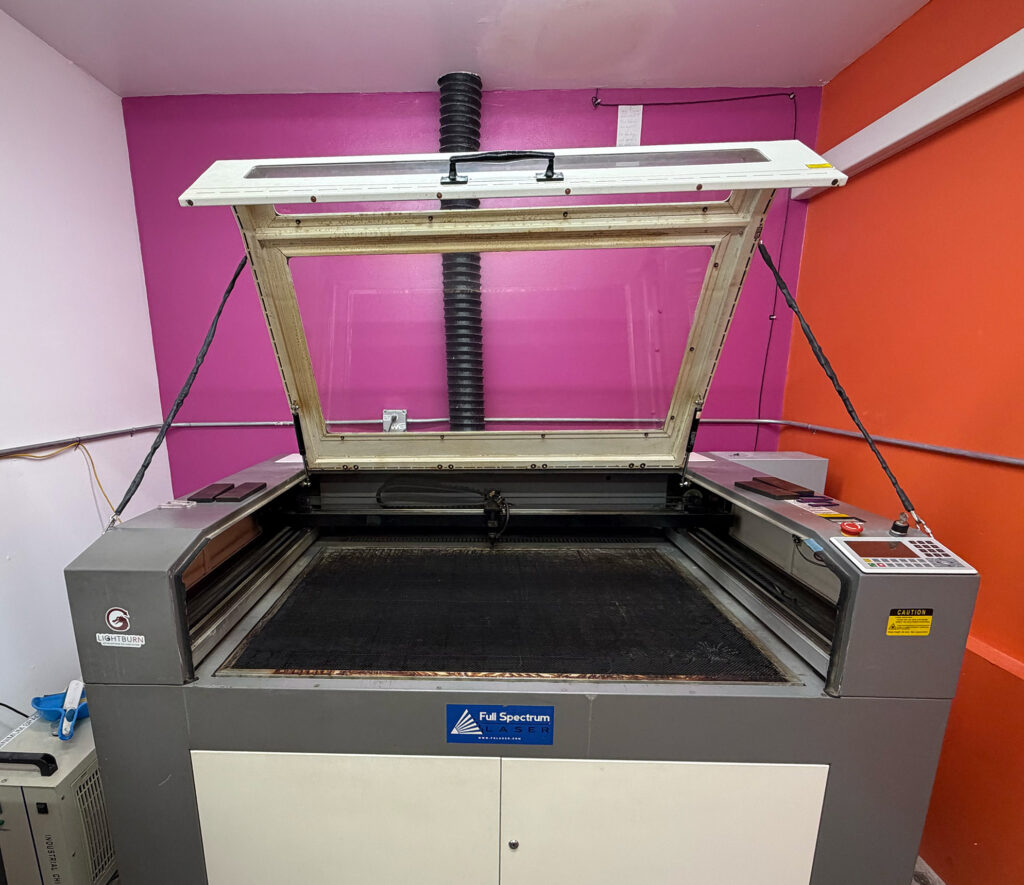
The lid has pneumatic lifters, one on each side. These make it much easier to lift the heavy lid, and they keep the lid up after you’ve lifted it. However, the lifters get tired over months and years of use, and the open angle of the lid begins to droop. My idea for coping with this problem is to add cables, one on each side of the lid, that constrain exactly how high the lid can be opened. The pneumatic lifters will push against the cables to reach the same maximum height every time.
The cables are made out of eighth-inch stainless steel wire rope, with standard hardware, including a turnbuckle to allow each cable to be adjusted in length. Because the wire rope has sharp ends in multiple places, I’ve encased the wire rope and most of its hardware in a protective plastic sheath. A carabiner at each cable end then clips to a screw eye installed in the lid or chassis. Here’s what that looks like today:
Camera installation and calibration will be the next step.
We’ve held 15 sessions of the Laser Basic Operations and Safety class over the last six months. These classes were announced only to people already on the waiting list, and they filled up rapidly. We will continue to hold classes at a similar accelerated pace as long as they continue to fill up.
Go to the class signup page on the Colab web site here and check for class availability. If you don’t see any classes available and want to attend a class anytime soon, I recommend you sign up for the waiting list. We will continue to notify people on the waiting list by email before we open the classes for everybody.
If you took the laser class before we moved to the current Colab location on Mission Gorge Place, you learned to use the Full Spectrum Laser with its original Retina Engrave 3D electronics and software. Since then, we have upgraded to a Ruida laser controller and LightBurn software, and operation of this new configuration is somewhat different. You’re free to sign up for the updated basic class, in which you will learn the differences and refresh your memory of everything else, including safety rules. Or, you can wait for us to put together a shorter refresher course that concentrates on just the differences.
Classes for the laser are now being scheduled on the sdcolab.org web site.
We have scheduled, and already filled up, six classes between September 16 and September 25. More classes are due to be scheduled on an ongoing basis after that. Visit that web site to sign up or be added to the waiting list.
I hope you’re as excited as I am to see regular laser classes and routine laser use begin again!
I’ve updated the comprehensive Laser Job Checklist to match the new laser configuration and software environment. You can get a PDF copy in the Downloads section on this site.
The laser has been re-relocated to its new home at the new permanent location of Colab, at 4667 Mission Gorge Place, Suite A, in San Diego. Thanks to the great work of Jolly Rancher and many other volunteers, the laser has its own air-conditioned space with all-new exhaust ventilation to outdoors. The laser tube has been re-installed. A few finishing touches remain before the laser can be operated. After that, a thorough alignment and tuning is all that should be needed before the laser can return to regular service.
That is, if nothing else goes wrong. One of the finishing touches planned for the work session on Tuesday (April 8, 2025) was to refill the water cooling system that keeps the laser tube cool during operation. After adding the first gallon of distilled water to the chiller, we had about half a gallon of water on the floor. Investigation revealed that one of the tubes inside chiller had become brittle with age, and cracked in several places. Most of the tubes in the chiller are silicone and are still in good condition, but that one tube was clear polyurethane. That tube serves as a sight glass to judge the water level, so it has to be transparent. I didn’t find a local source for polyurethane tubing, but the blessedly nearby Home Depot was able to supply clear vinyl tubing in the same size. With the new tubing installed, the chiller no longer leaks. That little side quest consumed the remaining time in the Tuesday work session, though. The next step is to run the cooling water into the laser tube.
Speaking of the laser tube, it was practically new when Covid hit, but laser tubes of this type also have a limited shelf life. Five years later, it’s possible that the tube won’t work at all, or won’t work as well as it did when new. Once we have the cooling water working, we will test it and find out.
CoLab is (and has been for a while) available for single-user access and small groups from the same household for machine use by appointment only. Go to the Schedule page and request access as usual if you want to use the laser on these terms, or email info@sdcolab.org if you have questions about the policy.
Indoor classes, including our laser safety classes, are still considered unsafe. Classes will resume as soon as conditions permit.
Yesterday I took the laser partway apart, looking for reasons why the Z-axis table keeps getting out of alignment. I think I know more than I did before, but I still don’t fully understand what’s happening. The problem seems to be in the acme threaded nut that rides up and down on the right rear acme threaded rod. You can hear the mechanism going “clunk clunk clunk” when that corner is slipping out of alignment.
This mainly seems to happen when the table is going UP in the FAST Z mode. That makes sense, because that’s when the mechanism is working hardest to lift the weight on the table, the honeycomb mesh, and your workpiece.
So, I am asking all laser users to please avoid using FAST Z motion until I’m able to isolate and fix the problem. It may take you a few extra seconds to focus using SLOW Z only, but it will help keep the table aligned and the laser working well. Thanks for your cooperation.
Update: problem has been fixed. You may use FAST Z motion normally unless you encounter that “clunk clunk clunk” sound again.